Your Legal Safety Net: Why Every Business Needs a Clean Bill of Health
Your Legal Safety Net: Why Every Business Needs a Clean Bill of Health
The $50,000 scramble you can avoid with proactive legal planning
I will never forget the first time I received one of those calls.
A successful business owner contacted me with exciting news. After years of building his company, he finally had an investor ready to write a substantial check. The term sheet was signed. The deal was moving forward. There was just one small requirement: the investor needed to review his corporate documentation as part of due diligence.
Simple enough, right?
Except when we started gathering documents, we discovered problems. The operating agreement existed but had never been signed by all partners. Meeting minutes from the past three years were nonexistent. The cap table showed ownership percentages that no longer matched reality after an informal equity adjustment two years prior. Organizational resolutions for major decisions were missing.
What should have taken two weeks took over 10 months. What should have cost a few thousand dollars in legal review ballooned to over $40,000 in document reconstruction and cleanup. The investor grew impatient. By the time we finished, the deal had fallen apart.
This business owner is not alone. I have seen this scenario play out dozens of times with different variations. A partner dispute erupts and no one can locate the partnership agreement. A bank requests corporate records for a loan and discovers the entity fell out of good standing years ago. A potential acquirer walks away after seeing disorganized, incomplete documentation. A landlord demands written proof of authority to sign a commercial lease amendment—and the “right” document can’t be found. A buyer asks for clean diligence during an entity purchase, and the gaps in governance and ownership slow everything down.
The pattern is always the same: businesses operating without a clean legal foundation until the moment they desperately need one.
The Hidden Cost of Reactive Legal Work
Most business owners think about legal work the same way they think about going to the dentist. You avoid it until there is pain, then you deal with the emergency.
But reactive legal work costs far more than proactive planning.
It is not uncommon for businesses to spend months—and tens of thousands of dollars—cleaning up documentation before a major transaction. Those numbers only tell part of the story.
You lose momentum. While you scramble to reconstruct meeting minutes and locate incorporation documents, your competitor is closing their funding round or acquisition.
You lose credibility. Investors and buyers wonder what else you have not managed properly. Disorganized legal documents signal disorganized operations.
You lose opportunities. Some deals have tight timelines. If you cannot produce clean documentation quickly, the opportunity disappears.
You lose sleep. Few things create more stress than realizing you cannot prove ownership of your own company or that critical agreements were never properly executed.
The irony is that most of this scrambling is completely preventable with basic organizational discipline and proactive legal planning.
What a Clean Legal Bill of Health Actually Means
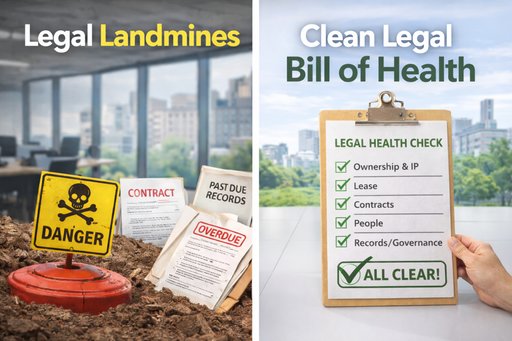
A Clean Legal Bill of Health (“CLBH”) means your business runs on current, organized legal documents. When a problem arises or when you want to grow or sell, you have exactly what you need. No guesswork. No missing paperwork. No months-long reconstruction projects.
Think of it as the business equivalent of maintaining your health through regular checkups, good nutrition, and exercise rather than waiting for a heart attack to force lifestyle changes.
A Clean Legal Bill of Health covers the core areas that create the most expensive surprises in due diligence, disputes, and commercial relationships. To keep this practical, I’ll start with three “core” components—then I’ll show you how they fit into the broader CLBH checkup.
Component 1: Your Entity and Records Stay Clean
Your legal entity is the foundation of everything else. When that foundation cracks, everything built on top becomes unstable.
Your LLC or corporation was formed properly and maintains good standing. This sounds basic, but you would be surprised how many businesses discover they were administratively dissolved when they apply for financing or try to enforce a contract. States require annual reports and fees. Miss them long enough and your entity ceases to exist in the eyes of the law.
Your incorporation documents and organizational resolutions exist and are accessible. Your articles of incorporation or organization. Your bylaws or operating agreement. Resolutions authorizing major actions like opening bank accounts, signing leases, or taking on debt. These documents prove your business exists and that specific people have authority to act on its behalf.
I once worked with a business owner who could not open a new bank account because he could not produce the organizational resolution authorizing him as the sole signer. The document had existed at one point but was lost in a computer crash years earlier. It took weeks to reconstruct.
You hold required meetings when state law or your governing documents mandate them. Many states require annual meetings for corporations. Your operating agreement or bylaws may require regular board or member meetings. These are not bureaucratic formalities. They demonstrate that your business is actively managed and that major decisions follow proper procedures.
You memorialize major decisions with written minutes and consents. Every significant business decision should be documented. Admitting new partners or shareholders. Approving a major contract or purchase. Changing officer roles or compensation. Authorizing a loan or line of credit. Approving a commercial lease, a major lease amendment, or a guarantee.
Why does documentation matter? Because memory fades and disputes arise. Three years from now, will everyone remember the exact terms of that verbal agreement about equity distribution? Will the bank accept your recollection of board approval for a loan, or will they want to see written minutes?
Your records stay current year after year. This is where many businesses fail. They start with good documentation but stop maintaining it. Officers change but the records are never updated. New equity is issued but the cap table stays the same. Meetings happen but minutes are never written.
The businesses that maintain clean records make it a routine practice, not a crisis response. They treat legal documentation like bookkeeping: something that happens regularly as part of business operations.
Why Clean Entity Records Matter
When your entity foundation is solid, everything else moves faster.
Investors complete due diligence in weeks instead of months because they are not waiting for you to reconstruct five years of missing records.
Banks approve loans without lengthy delays because you can immediately produce proof of good standing, organizational authority, and proper governance.
You demonstrate that you run a professionally managed business, which matters when sophisticated parties evaluate whether to work with you.
And when disputes arise, you have documentation to support your position instead of relying on fading memories and conflicting accounts.
Component 2: Your Ownership Relationship Is Clear
If clean entity records are your foundation, clear ownership documentation is your framework. This is where many businesses experience their most painful failures.
You have a signed operating agreement, partnership agreement, or buy-sell agreement. Not a handshake understanding. Not an unsigned draft sitting in someone's email from three years ago. A signed, binding document that all owners have reviewed and agreed to.
I cannot count the number of partnership disputes I have seen that trace back to one simple failure: no written agreement defining the relationship.
Two friends start a business together with a casual understanding. One contributes capital, the other contributes time. They agree to "split things fairly" without defining what that means. Five years later, the business is successful and they disagree about everything. Who has decision-making authority? How should profits be distributed? What happens if one wants to exit?
Without a written agreement, those questions get resolved through expensive litigation or the dissolution of the business and the friendship.
Your agreement covers the decisions that create conflict. A good operating or partnership agreement addresses the issues that cause disputes:
Roles and responsibilities. Who does what? Who has authority over which decisions?
Decision-making authority. Which decisions require unanimous consent? Which requires majority approval? What happens when partners deadlock?
Profit distributions. How and when are profits distributed? What if the business needs to retain earnings for growth?
Capital contributions. What happens if the business needs additional capital? Are partners required to contribute? What if they cannot or will not?
Exit procedures. What happens when a partner wants to leave? How is their ownership valued and purchased? What restrictions exist on transferring ownership to outsiders?
Dispute resolution. How are disagreements resolved? Through mediation? Arbitration? What process do partners follow before resorting to litigation?
The time to answer these questions is at the beginning of the relationship when everyone is optimistic and aligned, not in the middle of a dispute when positions have hardened and trust has eroded.
Your cap table and ownership documents match reality. Your capitalization table should accurately reflect who owns what percentage of your business. This sounds simple but becomes complicated quickly.
You issue equity to early employees as part of their compensation. You grant profits interests to key team members. You adjust ownership percentages when a partner leaves or a new partner joins. You bring on investors who receive preferred stock with special rights.
Each of these changes should be documented. The cap table should be updated. The relevant agreements and certificates should be executed and filed.
I have seen cap tables that bore no resemblance to actual ownership because changes were agreed to verbally but never documented. When that business tried to raise institutional funding, the investors walked away. They had no confidence that the ownership structure they were investing into was legally valid.
Why Ownership Clarity Matters
Clear ownership documentation prevents the conflicts that destroy businesses.
Partners cannot claim different ownership percentages during a dispute because the agreement and cap table are clear and signed.
There is no confusion about who has authority to sign contracts, take on debt, or make major decisions because the agreement defines decision-making power.
Distributions do not become battlegrounds because the formula or process was established when everyone was aligned.
Clear ownership also enables growth.
Financing rounds move smoothly because investors know exactly who owns what and what rights attach to different classes of ownership.
Exits proceed efficiently because buyout terms, valuation methods, and transfer restrictions were established years earlier when they could be negotiated fairly.
Employees accept equity compensation with confidence because the grants are properly documented and the cap table is maintained professionally.
The businesses that scale successfully are the businesses where ownership is clear, documented, and updated as circumstances change.
Component 3: Your Legal Work Supports Growth
The first two components focus on organization and clarity. This third component is about strategic advantage.
You have the documentation needed for scaling, financing, or an exit. Sophisticated investors and acquirers have checklists of required documents. Entity formation documents. Operating agreements. Cap tables. Board minutes and written consents. Material contracts. Intellectual property assignments. Employment agreements. Commercial leases and lease amendments. Key vendor and customer agreements.
If you maintain clean records from the beginning, producing these documents is easy. If you do not, you face months of reconstruction before any transaction can proceed.
You do not spend months cleaning up governance and ownership gaps before a transaction. Time kills deals. The longer due diligence takes, the more opportunities arise for buyers to find problems, for market conditions to change, or for deal fatigue to set in.
The businesses that close transactions quickly are the businesses where due diligence reveals an organized, well-documented company. No surprises. No missing pieces. No red flags that require lengthy investigation. That’s especially true in entity purchases, where the buyer is paying for certainty.
You prevent disputes by doing proactive legal work early. Most business disputes are preventable. They arise from ambiguity, unmet expectations, and poor communication.
Written agreements force clarity. They require partners to discuss difficult topics before they become problems. They establish procedures for resolving disagreements before positions harden.
The cost of drafting a comprehensive operating agreement is a fraction of the cost of litigating ownership disputes for years.
The time invested in creating clear employment agreements and equity documentation prevents wrongful termination claims and equity disputes down the road.
The discipline of maintaining corporate records and documenting major decisions creates a paper trail that protects you when questions arise.
Proactive legal work is not about generating unnecessary legal fees. It is about building a foundation that makes everything else easier and prevents expensive problems before they start.
How This Fits the Broader “CLBH” Checkup
If you’ve followed my work, you’ll notice I don’t treat a Clean Legal Bill of Health as “just entity docs.” It’s a practical audit across the major legal risk areas that trigger litigation, stall deals, or create leverage for the other side; especially around ownership agreements, commercial leases, and buying or selling an entity. The three components above are the starting point because they create the fastest wins and the biggest reductions in avoidable scramble-cost.
The Simple Test Every Business Should Take
Here is how you know whether your business has a Clean Legal Bill of Health.
Imagine you receive a demand letter tomorrow. A former partner claims you owe them money. A vendor alleges you breached a contract. An employee threatens a lawsuit.
Could you immediately access the documents you need to defend yourself? Your operating agreement showing ownership percentages? The written consent documenting the decision in question? The contract terms both parties agreed to? Your signed commercial lease and amendments?
Or would you spend days searching through disorganized files, old computers, and email accounts hoping to find something useful?
Now imagine you receive a call from a buyer interested in acquiring your business this year. They want to move quickly. Can you hand over a clean file of documents within a week?
Your articles of incorporation and good standing certificate. Your operating agreement. Your cap table. Meeting minutes from the past several years. Material contracts. Employment agreements. Intellectual property documentation. Your lease file (lease, amendments, estoppels if you have them, guaranties if applicable).
Or would you need three months to reconstruct, locate, and organize documents that should have been maintained all along?
Your answer to these scenarios reveals whether you have a legal safety net or a scramble plan.
Moving from Reactive to Proactive: What It Actually Looks Like
The best time to organize your legal house is before you need it. The second best time is now.
Proactive legal planning is not complicated. It requires discipline and routine rather than heroic effort.
Conduct annual reviews of your entity status. Every year, verify your business is in good standing with the state. Confirm you filed required reports and paid necessary fees. Update your records to reflect any changes in officers, directors, or managers. This takes a few hours annually and prevents the administrative dissolution that catches many businesses by surprise.
Document major decisions as they happen. When your business makes a significant decision, document it immediately with meeting minutes or a written consent. Approved a major purchase? Document it. Changed officer roles? Document it. Took on new debt? Document it. Signed a new commercial lease or negotiated a major lease amendment? Document the approvals and keep the “lease file” current. This habit takes minutes per decision but creates a comprehensive record of your business governance.
Maintain current agreements that reflect reality. When ownership changes, update your operating agreement and cap table. When roles change, update your bylaws or employment agreements. When business relationships evolve, update your contracts. Do not let your documentation drift away from reality.
Organize your files so any document can be located within minutes. Create a system for storing corporate records, agreements, and important documents. Digital is fine as long as you have backups. Physical is fine as long as you have organization. The key is that you or anyone who needs access can find documents quickly without heroic searching.
Schedule regular updates as your business changes. Do not wait for a crisis to trigger a massive catch-up project. Build legal documentation into your regular business rhythm. Quarterly reviews of corporate records. Annual reviews of agreements. Immediate documentation of major decisions.
This is not about creating unnecessary legal work or drowning in bureaucracy. This is about building a foundation that makes everything else easier.
What Happens When Your Legal House Is in Order
When your documentation is clean and current, opportunities move faster.
An investor expresses interest and you can complete due diligence in three weeks instead of three months because every document they request is immediately available.
A bank approves your loan application quickly because you can produce your articles of incorporation, operating agreement, meeting minutes, and good standing certificate the same day they request them.
A potential acquirer sees a professionally managed business and gains confidence that your operations match the quality of your documentation.
Disputes get resolved efficiently because agreements are clear and documentation exists to support positions. You avoid the "he said, she said" battles that drag on for years.
Partners know their rights and responsibilities because they are written down and agreed to. Employees understand their equity arrangements because grants are properly documented.
You make better decisions because you have clarity about ownership, authority, and governance. You know who needs to approve major actions. You understand how decisions should be made.
And when problems do arise, you have the documentation to protect yourself. The operating agreement that defines ownership. The meeting minutes that show proper authorization. The contracts that spell out each party's obligations.
Your legal foundation becomes your safety net. It catches problems before they become catastrophes. It supports growth instead of creating obstacles. It gives you confidence that your business is built on solid ground.
Take Action Today: Your 15-Minute Legal Health Check
You do not need to fix everything at once. Start by understanding where you stand.
Take 15 minutes this week to answer these questions honestly:
Can you locate your operating agreement or partnership agreement right now? Not "I think it is somewhere." Can you put your hands on a signed copy within five minutes?
Do you know your entity's good standing status with the state? When did you last file an annual report? Have you paid all required fees? Can you produce a current good standing certificate?
When did you last hold a formal meeting or document a major decision? Have you created any written minutes or consents in the past year? The past two years?
Does your cap table accurately reflect current ownership? If you printed your cap table today, would it show the correct ownership percentages and accurately account for all equity that has been issued?
If an investor asked for due diligence documents tomorrow, how long would it take you to compile them? Hours? Days? Weeks? Months?
If you have a commercial lease: can you locate the fully executed lease, amendments, and any guarantee within five minutes?
Your answers reveal whether you have a legal safety net or a scramble plan.
The Bottom Line
Your legal foundation should help you build, not force you to stop and reconstruct.
Every successful business reaches inflection points. A funding opportunity. An acquisition offer. A partnership dispute. A major contract negotiation. A regulatory inquiry.
At those moments, you want clean documentation that supports your position and enables fast action. You do not want to discover that critical documents are missing, agreements were never signed, or your entity is not in good standing.
The businesses that scale are the businesses built on solid legal foundations. They invest in proactive planning rather than reactive scrambling. They maintain clean records as part of routine operations. They document ownership clearly and keep it current.
The time to build your legal safety net is before you need it. Before the demand letter arrives. Before the investor asks for documents. Before the dispute erupts.
Because when opportunity knocks or problems arise, you want to be ready. You want to hand over a clean file of documents and keep building.
That readiness separates businesses that scale from businesses that stall.
Ready to build your legal foundation?
If you are tired of reactive scrambling and ready for proactive planning, we can help. At Jeppson Law, we work with business owners to organize their legal house so opportunities do not turn into months-long documentation projects.
We help you establish clean entity records, create clear ownership documentation, and build systems that keep everything current as your business grows.
Because your legal foundation should be your competitive advantage, not your crisis.
Start with a Clean Legal Bill of Health (CLBH) audit. It’s a flat-fee, structured review designed to (1) identify your biggest legal exposure points, (2) prioritize fixes, and (3) give you a clear plan; either as a menu of flat-fee projects or a subscription path where we implement it over time.
What legal question keeps you up at night? Email me directly at ejeppson@jeppsonlaw.com and let's talk about it.