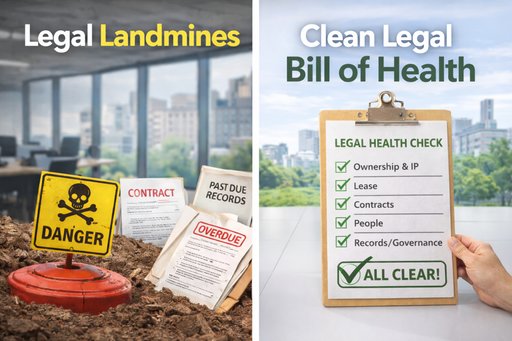
Finding Your Biggest Legal Landmines
How to Spot Problems Before They Blow Up Your Business
If you're a business owner, you already know you're taking risks every day. That's part of the job. The problem isn't the risk itself—it's the hidden legal landmines you don't see until you step on them.
A landmine isn't the thing you know is risky and choose to handle anyway. It's the lease clause you skimmed, the contractor you treat like an employee, the ownership handshake you never wrote down. Everything looks fine until one day it isn't, and now lawyers, courts, and unexpected bills are running your calendar.
This post is about finding those landmines while they're still quiet and fixable.
LEGAL LANDMINE #1: WHO REALLY OWNS WHAT
The first and loudest landmine is ownership and control.
Questions to ask yourself:
- If I had to part ways with a partner tomorrow, do our documents explain how that works?
- Are ownership percentages written down, signed, and consistent with reality?
- Does the company clearly own the intellectual property, or is it still technically in the name of a founder, employee, or contractor?
- If something happened to me, would my family and my team know who's in charge and what happens to my shares?
Where the landmine hides:
Many businesses are formed with a quick online filing and a handshake agreement. Operating agreements, bylaws, shareholder agreements, and IP assignments get pushed off to "later." That works exactly as long as everyone gets along and nothing goes wrong.
When you feel the explosion:
- A founder wants out or wants to sell
- A key employee or partner leaves and claims rights to ideas or inventions
- An investor wants clean documentation and you don't have it
LEGAL LANDMINE #2: YOUR COMMERCIAL LEASE
Your lease is often your biggest ongoing obligation. It's also one of the most misunderstood documents in a business.
Questions to ask:
- Do I know when my lease ends and what happens at renewal?
- Do I understand what I'm really paying for, including CAM, taxes, and insurance?
- What does my personal guarantee actually cover, and for how long?
- Can I sell my business or bring in a partner without the landlord being able to block it?
Where the landmine hides:
Risk is usually buried in vague language about "operating expenses," "changes in control," or "assignment." You may think it only matters if you move out. In reality, it often matters when you grow, change ownership, or want to sell.
When you feel the explosion:
- Surprise increases in monthly payments because of fees you didn't realize you agreed to
- A landlord using your lease as leverage when you try to sell or bring in investors
- Personal assets at risk because of a guarantee you barely remember signing
LEGAL LANDMINE #3: CONTRACTS THAT ARE VAGUE OR OUT OF DATE
Most businesses have contracts pulled from somewhere—an old template, a friend, the internet. They worked "fine" at first. Then the business changed, but the contracts didn't.
Questions to ask:
- Are my top customer and vendor relationships documented in clear written contracts?
- Do those contracts match how we actually work today, not how we worked three years ago?
- Is it clear what happens if someone doesn't pay, delivers late, or does poor work?
- Are deadlines, scope, and payment terms written in plain, specific language?
Where the landmine hides:
Vagueness. Assumptions. Side emails that contradict the contract. Shortcuts like "we'll figure it out later."
When you feel the explosion:
- A customer refuses to pay, and you realize the contract never spelled out the payment schedule or late fees
- A vendor or contractor underperforms, and you have nothing clear to point to
- A dispute over "what we agreed to" that turns into a lawsuit or an expensive settlement
LEGAL LANDMINE #4: EMPLOYEES AND CONTRACTORS
As soon as you bring people into the business, you have legal exposure. A lot of it is manageable, but only if you pay attention early.
Questions to ask:
- Are the people who work for us properly classified as employees or independent contractors?
- Do we have basic written offers, agreements, and policies in place?
- Are we following wage and hour rules for things like overtime and breaks?
- Do we use confidentiality agreements where it actually matters?
Where the landmine hides:
In habits. Paying people as contractors to "keep it simple." Letting policies live in your head instead of on paper. Assuming you're too small for anyone to care.
When you feel the explosion:
- A worker claims they were misclassified and seeks back pay
- A former team member walks away with confidential information or client lists
- A government agency or plaintiff's lawyer comes knocking with questions you can't easily answer
LEGAL LANDMINE #5: MISSING MEETING MINUTES AND CORPORATE RECORDS
Corporate governance sounds boring until you're in court. Then it becomes Exhibit A.
Questions to ask:
- When was the last time we documented a shareholder or board meeting?
- Are big decisions recorded anywhere besides email and memory?
- Do our records match what actually happened with ownership, officers, and major transactions?
Where the landmine hides:
In the busy years. You intend to "catch up" on your records, but by then, memories have faded and documents are scattered.
When you feel the explosion:
- A dispute about who approved what and when
- A challenge to your authority as an owner or officer
- A fight over IP or corporate decisions that could have been clarified with simple minutes
HOW TO FIND YOUR BIGGEST LANDMINES IN ONE HOUR
Here's a quick exercise you can actually do.
Step 1: Grab a notepad and write five headings:
- Ownership and IP
- Lease
- Contracts
- People
- Records and governance
Step 2: Under each heading, write two columns:
- "Confident about"
- "Not sure about"
Step 3: Spend 10 minutes per heading and be brutally honest. If you feel even a little knot in your stomach, put that item in the "Not sure about" column. You're not trying to solve anything yet—you're simply mapping where the landmines might be.
Step 4: Circle the three items that would hurt the most if they went wrong.
Those are your biggest landmines. That's where prevention will pay off the fastest.
WHAT TO DO ONCE YOU FIND THEM
Once you have your top three:
- Decide which ones you can handle with better internal systems and which ones need legal help
- Set a realistic timeline (for example: "We'll clean up our lease and one key contract this quarter")
- Talk with a lawyer in a way that fits your budget—ideally with flat fees or a subscription so you're not afraid to ask questions early
The goal isn't perfection. The goal is to shrink the probability that a hidden problem will blow up your year.
A FINAL WORD
Most business owners are already carrying a lot. You're juggling sales, hiring, operations, and family. It's completely understandable that legal issues you can't see don't feel urgent.
But the truth is, your biggest legal landmines are usually sitting quietly in documents you already signed or in decisions that never got documented at all.
Finding them now is an act of protection for your future self. An ounce of prevention really is worth a pound of cure—especially when that cure looks like years of litigation, distraction, and stress.
If you want help turning your list of "not sure about" items into a clear plan, this is exactly what a Clean Legal Bill of Health is for.