
Don’t Wait for the Lawsuit: The 6 Places Legal Risk Hides in Your Business
Adapted from Eric Jeppson's webinar, "Your Business Deserves a Clean Legal Bill of Health." Watch the full replay on YouTube.
If you asked me for the most expensive word in business law, I wouldn't say "lawsuit." I'd say "later."
Later is the operating agreement you signed nine years ago, when there were two of you and a truck. Later is the subcontractor agreement you pulled from a template site because you needed it that afternoon. Later is the change order you agreed to over the phone because you've worked with that client for six years and it's fine.
None of it feels urgent. The work is getting done, customers are paying, and nobody is suing. So it goes on the list, right under updating the website. Then a customer disputes an invoice, a partner wants out, or a buyer's attorney requests documents, and later it becomes urgent.
This isn't meant to scare you. The numbers below are real, and some are large. But nearly everything in this post is fixable, and the earlier you look, the easier it is.
What later actually costs
Small businesses carry an outsized share of the bill. A 2023 study by the U.S. Chamber's Institute for Legal Reform found that small businesses paid about $160 billion in liability costs in one year. That was 48% of all commercial liability costs, even though small businesses generate only about 20% of business revenue.
The reason is structural. Large companies have in-house lawyers and risk departments whose entire job is to find problems before they become claims. In most established small businesses, the owner is the risk department, along with sales, operations, and the person who fixes the printer.
One dispute can take a year. Hiscox, a small-business insurer, found that the average employee lawsuit cost a small business about $160,000 to defend and settle and took 318 days to resolve. That's almost a year of document requests, calls with your insurer, and attention you aren't giving to customers or crews.
Going it alone often costs more. In a 2026 LegalShield survey, 52% of small business owners said they handled their most recent legal issue themselves. Nearly three in four lost money, and about one in four lost between $25,000 and $100,000. Doing it yourself is how you built the business. Legal is the one area where you can't see the missing clause until you need it.
The exposure is growing in a few clear areas. Hiscox's 2025 report found that 77% of U.S. small businesses are underinsured. Verizon's 2025 breach report found ransomware in 88% of breaches at small and mid-sized businesses. The EEOC received more than 88,000 new discrimination charges in fiscal 2024, up more than 9%.
Your business is likely your biggest asset. The Exit Planning Institute estimates that 80% to 90% of a typical owner's wealth is tied up in the business. When a buyer shows up, their attorney requests the operating agreement, customer contracts, employee files, and insurance history. Every gap they find becomes a reason to lower the price or withhold part of the payment.
Why good owners put it off
Nobody waits because they don't care. They wait for very human reasons, and the same five come up again and again:
It's too expensive. In the same LegalShield survey, 65% of owners said cost was the biggest barrier. Hourly billing with no ceiling fueled that fear.
It's too early. Research from ideas42 found that 63% of owners without a succession plan said it was too early, and 45% said they were too busy.
Nothing is wrong. No lawsuit, no demand letter. That's exactly the best time to look, because you still have options.
I don't know what to ask. Nobody hands you a checklist for the legal side of a business. They teach you to bid a job, not to read an indemnity clause.
Lawyers mean trouble. Most owners call an attorney only when something is already on fire.
Every one of those has an answer. That's why we built a different model.
What a Clean Legal Bill of Health is
The old model goes like this: something goes wrong, you call a lawyer, you pay by the hour, and you learn the cost after the work is done. The fire is already burning.
A Clean Legal Bill of Health works the other way. It's a structured legal checkup across the six areas where business risk hides, followed by a clear, flat-fee plan to fix what needs fixing. Think of how a good doctor handles a patient who feels fine. They don't wait for symptoms. They check the basics in a set order so nothing important gets skipped.
Each area receives one of three scores:
Healthy: in good shape. Keep it current and look at it once a year.
Worth a look: something exists, but it's outdated, incomplete, or informal. An operating agreement signed before a partner changed is a classic example.
Fix now: something important is missing. That's where you start.
Most businesses have a mix. Almost nobody is entirely Healthy, and almost nobody is entirely Fix now. Our tagline sums it up: Find it before it finds you™.
The six places legal risk hides
Almost every dispute we see starts in one of these six places, not in the quality of the work but in the paperwork around it. Nobody sues a plumber over the plumbing. They sue over the contract, the change order, the employee, or the insurance claim.
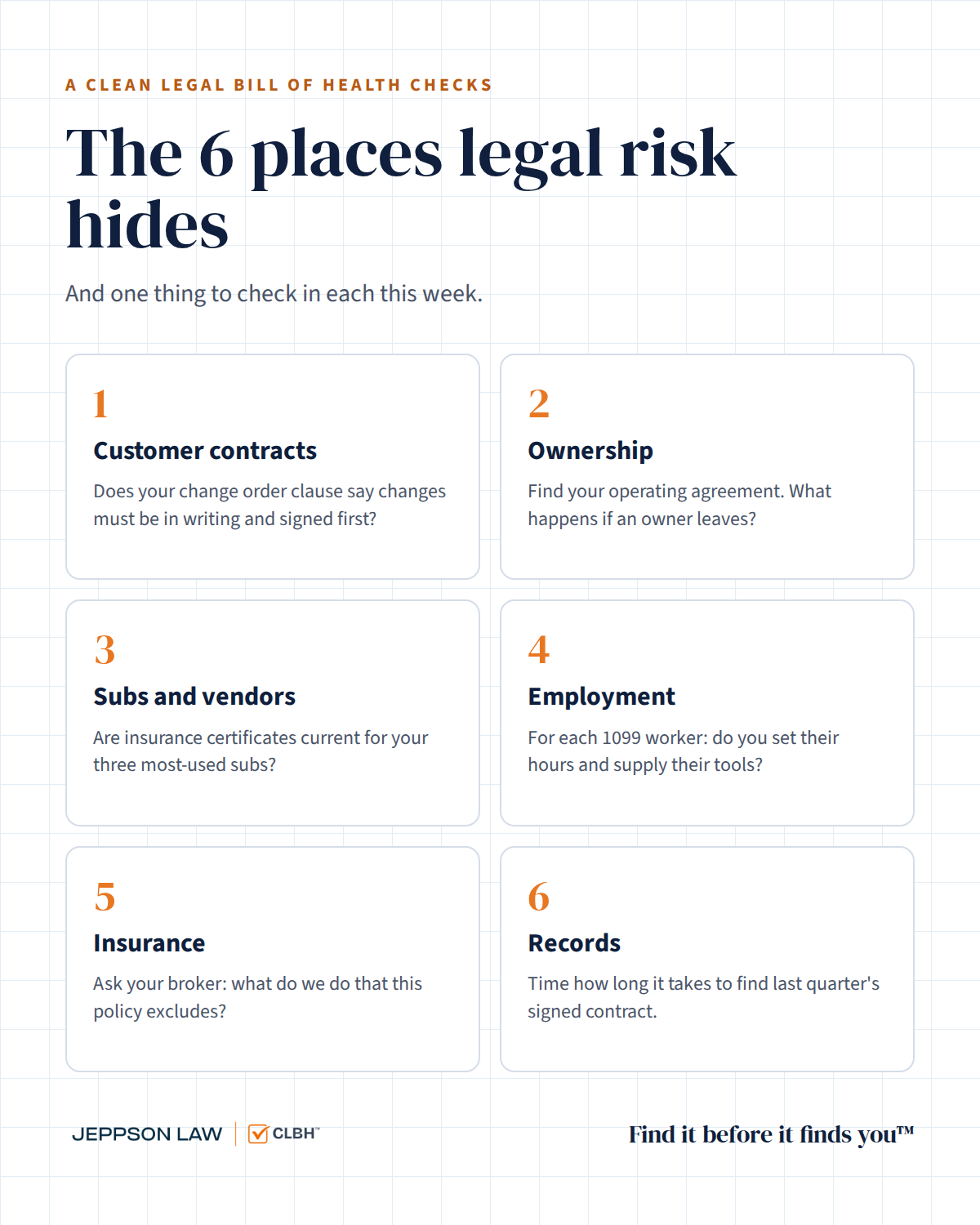
1. Customer contracts and project risk
The job runs long, the client requests a change, and you say yes on the phone. Then the invoice comes back short, and you're arguing over a conversation nobody wrote down. Common gaps: a contract template nobody has touched in years, changes agreed to by phone or text, and vague terms for scope and payment.
Check this week: pull your customer contract and find the change order clause. If it doesn't state that changes must be in writing and signed before work begins, that's worth a look.
2. Ownership and governance
Could your business survive a partner dispute or an owner's exit? Common gaps: an operating agreement that no longer reflects how the business runs, no written plan for what happens if an owner dies, becomes disabled, or wants to leave, and personal and company funds mixed together.
Check this week: find your operating agreement or bylaws and read the section on what happens if an owner leaves. This is also the first thing a buyer's attorney requests.
3. Subcontractors and vendors
When you bring in a sub, you hand them your customer and your reputation. Common gaps: subs working on a handshake, no current certificate of insurance on file, and no written agreement specifying who's responsible if their work causes damage.
Check this week: pull the insurance certificates for your three most-used subs. Are they up to date?
4. Employment and safety
A study commissioned by the Department of Labor found that up to 30% of audited firms had workers misclassified as independent contractors. Calling someone a 1099 doesn't make them one. Common gaps: 1099 workers who function like employees, an outdated handbook, and safety training that occurs but isn't documented.
Check this week: list everyone you pay on a 1099. Do you set their hours? Do you supply their tools? Do they work only for you? A lot of yeses is worth a conversation.
5. Insurance and claims readiness
Most policies were bought for a smaller version of the business. Common gaps: exclusions that nobody has read, no cyber or employment coverage, and missed notice deadlines that can cost you the coverage you paid for.
Check this week: call your broker and ask one question: what do we do that this policy excludes?
6. Systems, records, and digital risk
Nothing you can't find will help you. Common gaps: signed contracts stored in text threads and glove boxes, former employees who still have passwords, and no plan for a ransomware attack.
Check this week: pick a job you finished last quarter and time how long it takes to locate the signed contract. If it takes more than five minutes, that's where to start. It's usually the least expensive fix on the list.
What a clean bill of health gives you
Found early, these gaps are small, inexpensive, and routine to fix. Found in the middle of a dispute or a sale, they cost time, money, and leverage. A clean bill of health means fewer surprises, room to hire or add a location without that nagging feeling, a flat fee you can budget for, and a business you can hand to a buyer's attorney with confidence.
The Clean Legal Bill of Health audit is the comprehensive version of everything above. An attorney reviews your actual documents across all six areas, scores each one, and walks you through a prioritized plan in plain English. It's a flat fee based on your revenue, quoted before any work begins.
Three things to do this week
You don't need to fix six things this week. You just need to know which ones are open.
Do one check on your own. If you're not sure where to start, start with the change order clause in your customer contract.
Book a free 15-minute legal health call. Eric will ask a few questions and tell you which area he'd look at first. Book your call.
Not ready for a call? Take the free Legal Health Checkup and see where you stand. It's 12 questions and takes 5 to 10 minutes.
You didn't start your business to spend your time in disputes. You started it to build something. Find it before it finds you™.
This article is general information, not legal advice. Reading it or contacting us does not create an attorney-client relationship.1. Customer contracts and project risk
The job runs long, the client requests a change, and you say yes on the phone. Then the invoice comes back short, and you're arguing over a conversation nobody wrote down. Common gaps: a contract template nobody has touched in years, changes agreed to by phone or text, and vague terms for scope and payment.
Check this week: pull your customer contract and find the change order clause. If it doesn't state that changes must be in writing and signed before work begins, that's Worth a look.
2. Ownership and governance
Could your business survive a partner dispute or an owner's exit? Common gaps: an operating agreement that no longer reflects how the business runs, no written plan for what happens if an owner dies, becomes disabled, or wants to leave, and personal and company funds mixed together.
Check this week: find your operating agreement or bylaws and read the section on what happens if an owner leaves. This is also the first thing a buyer's attorney requests.
3. Subcontractors and vendors
When you bring in a sub, you hand them your customer and your reputation. Common gaps: subs working on a handshake, no current certificate of insurance on file, and no written agreement specifying who's responsible if their work causes damage.
Check this week: pull the insurance certificates for your three most-used subs. Are they up to date?
4. Employment and safety
A study commissioned by the Department of Labor found that up to 30% of audited firms had workers misclassified as independent contractors. Calling someone a 1099 doesn't make them one. Common gaps: 1099 workers who function like employees, an outdated handbook, and safety training that occurs but isn't documented.
Check this week: list everyone you pay on a 1099. Do you set their hours? Do you supply their tools? Do they work only for you? A lot of yeses is worth a conversation.
5. Insurance and claims readiness
Most policies were bought for a smaller version of the business. Common gaps: exclusions that nobody has read, no cyber or employment coverage, and missed notice deadlines that can cost you the coverage you paid for.
Check this week: call your broker and ask one question: what do we do that this policy excludes?
6. Systems, records, and digital risk
Nothing you can't find will help you. Common gaps: signed contracts stored in text threads and glove boxes, former employees who still have passwords, and no plan for a ransomware attack.
Check this week: pick a job you finished last quarter and time how long it takes to locate the signed contract. If it takes more than five minutes, that's where to start. It's usually the least expensive fix on the list.
What a clean bill of health gives you
Found early, these gaps are small, inexpensive, and routine to fix. Found in the middle of a dispute or a sale, they cost time, money, and leverage. A clean bill of health means fewer surprises, room to hire or add a location without that nagging feeling, a flat fee you can budget for, and a business you can hand to a buyer's attorney with confidence.
The Clean Legal Bill of Health audit is the comprehensive version of everything above. An attorney reviews your actual documents across all six areas, scores each one, and walks you through a prioritized plan in plain English. It's a flat fee based on your revenue, quoted before any work begins.
Three things to do this week
You don't need to fix six things this week. You just need to know which ones are open.
Do one check on your own. If you're not sure where to start, start with the change order clause in your customer contract.
Book a free 15-minute legal health call. Eric will ask a few questions and tell you which area he'd look at first. Book your call.
Not ready for a call? Take the free Legal Health Checkup and see where you stand. It's 12 questions and takes 5 to 10 minutes.
You didn't start your business to spend your time in disputes. You started it to build something. Find it before it finds you™.
Sources
$160B small business liability costs; 48% of costs vs. about 20% of revenue: U.S. Chamber Institute for Legal Reform, Dec 2023
$160K average employee claim; 318 days to resolve: Hiscox Guide to Employee Lawsuits, 2017
52% handled it alone; nearly 3 in 4 lost money; 1 in 4 lost $25K to $100K; 65% cite cost: LegalShield, May 2026
77% of small businesses underinsured: Hiscox Underinsurance Report, 2025
Ransomware in 88% of SMB breaches: Verizon Data Breach Investigations Report, 2025
88,000+ EEOC charges, up more than 9%: U.S. EEOC, FY2024
Up to 30% of audited firms misclassified workers: DOL-commissioned study, 2000 (via AFL-CIO DPE)
80% to 90% of owner wealth in the business: Exit Planning Institute
63% "too early," 45% "too busy": ideas42, 2025 (via Project Equity)
This article is general information, not legal advice. Reading it or contacting us does not create an attorney-client relationship.